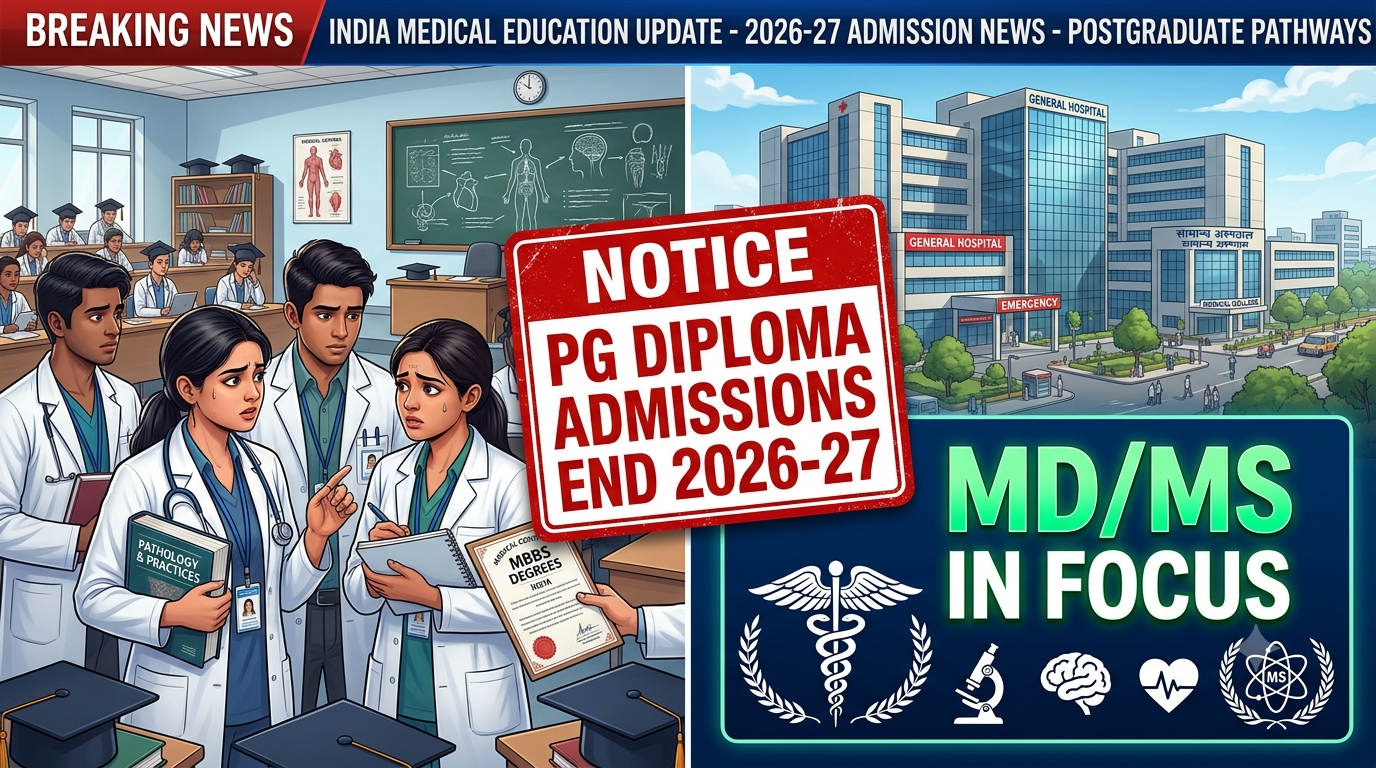
India’s medical education system is set to witness a significant transformation as the National Medical Commission (NMC) has decided to discontinue admissions to postgraduate (PG) diploma medical courses after the 2026-27 academic session. The move is aimed at creating a more uniform framework for specialist medical training across the country.
For decades, PG diploma courses have served as an alternative pathway for doctors seeking specialization in various medical fields. However, the latest decision indicates a clear shift towards MD (Doctor of Medicine) and MS (Master of Surgery) degree programmes as the standard qualifications for specialist doctors.
Medical students, healthcare professionals, and medical colleges across India are expected to be directly affected by this policy change. Understanding its implications is important for anyone planning a future in medical education.
Read the full article to know why PG diploma admissions are being discontinued, how the transition will take place, and what it means for aspiring doctors and medical institutions.
Why PG Diploma Courses Are Being Phased Out
The National Medical Commission has announced that the 2026-27 academic session will be the final year for admissions to PG diploma courses across India. From the 2027-28 academic year onward, no new admissions will be allowed in these programmes.
The decision is part of a broader effort to standardize postgraduate medical education and improve the quality of specialist training.
According to the commission, many medical colleges already have the necessary infrastructure and faculty strength required for MD and MS programmes.
Transitioning from diploma-based education to degree-based training is expected to create a more consistent qualification system for specialist doctors across the country.
How PG Diploma Courses Have Contributed to Healthcare
PG diploma courses have historically played an important role in India’s healthcare sector. These programmes offered doctors a shorter route to specialization compared to traditional MD and MS degrees.
They were particularly popular in disciplines such as:
• Anaesthesia
• Child Health
• Obstetrics and Gynaecology
• Ophthalmology
Many smaller hospitals and healthcare institutions benefited from diploma-trained specialists, helping bridge workforce gaps in underserved areas.
The shorter duration of diploma courses also enabled doctors to enter specialist practice more quickly, contributing to healthcare delivery in both urban and rural regions.
READ MORE: Best Vitamin Supplements in India: Your Complete Guide to Better Health
How the Transition to MD and MS Programmes Will Work
The NMC has provided a pathway for medical colleges to adapt to the new system. Institutions currently offering diploma programmes will have the opportunity to convert existing diploma seats into equivalent MD or MS seats.
Applications for conversion will be processed through the Medical Assessment and Rating Board (MARB), which operates under the National Medical Commission.
A dedicated online application system and detailed implementation timelines are expected to be announced separately.
This transition is intended to strengthen specialist education without requiring colleges to create entirely new academic structures.
Impact on Medical Colleges and Students
The policy change will have a direct impact on both educational institutions and aspiring medical professionals.
Medical colleges that currently depend on diploma programmes will need to restructure their postgraduate education offerings.
At the same time, students planning specialist careers must now focus on MD and MS pathways for future admissions.
Some of the major expected impacts include:
- Greater uniformity in specialist medical qualifications.
- Increased focus on comprehensive degree-based training.
- Expansion of MD and MS seats in medical colleges.
- Improved standardization of specialist education nationwide.
While the long-term benefits may be substantial, experts believe that careful implementation will be essential to avoid disruptions in specialist training capacity.
Connection With Existing Medical Education Regulations
The latest announcement is not an isolated decision. It builds upon provisions already introduced under the Post-Graduate Medical Education Regulations (PGMER), 2023.
Under these regulations, medical colleges were already allowed to apply for the conversion of diploma seats into degree seats.
The rules had also restricted the introduction of new diploma programmes and limited seat expansion in existing diploma courses.
By setting a final deadline for admissions, the NMC has now established a clear roadmap for completing the transition from diploma-based specialist education to a fully degree-oriented system.
The change is expected to encourage colleges to invest more in infrastructure, faculty development, and advanced clinical training facilities.
Future of Specialist Medical Training in India
India’s healthcare system continues to require a large number of qualified specialists to meet growing patient demands. The shift towards MD and MS programmes is expected to improve training standards and create a more consistent educational framework.
However, experts have also highlighted the need to maintain adequate specialist training capacity during the transition period. Regions that have traditionally relied on diploma-trained specialists may require additional support to ensure uninterrupted healthcare services.
The coming years will be crucial as medical colleges prepare for the conversion process and adapt to new educational requirements.
If implemented effectively, the policy could strengthen the quality of postgraduate medical education while ensuring that future specialists receive comprehensive and standardized training.
Frequently Asked Questions (FAQ)
Q1. When will PG diploma admissions officially end in India?
PG diploma admissions will continue until the 2026-27 academic session. From 2027-28 onward, new admissions will not be permitted.
Q2. Why is the National Medical Commission discontinuing diploma courses?
The decision aims to create a uniform postgraduate medical education system focused on MD and MS degree programmes.
Q3. Can medical colleges convert diploma seats into degree seats?
Yes. Medical colleges can apply to convert existing diploma seats into corresponding MD or MS seats through MARB.
Q4. Will MD and MS become the standard specialist qualifications?
Yes. The new framework is designed to make MD and MS degrees the primary qualifications for specialist medical practice.
Q5. How will students be affected by this change?
Future students seeking specialist training will need to pursue MD or MS programmes instead of PG diploma courses.
India’s medical education landscape is entering a new phase with the gradual discontinuation of PG diploma admissions. As the healthcare sector evolves, the focus will increasingly shift toward degree-based specialist training. The success of this transition will depend on how effectively medical colleges adapt and whether the expansion of MD and MS programmes can meet the country’s growing demand for skilled specialists.